Showing posts with label policy specs. Show all posts

Sunday, February 17, 2013

CA's Experiment with Redevelopment Agencies

California Governor Jerry Brown began deliberations with the Legislature over dissolving the state’s 400 redevelopment agencies in the winter of 2011, and by June of that year they finalized the legislation. The abrupt demise of California’s massive multi-billion dollar local planning instrument has left many cities with administrative gaps in their economic development initiatives, and nearly $2 billion remain in limbo while local governments struggle to keep funds in their jurisdiction. 

Sacramento contests that local redevelopment agencies were choking off much-needed revenue for state services with little benefit to the state at large, while local governments defended them as powerful tools for revitalizing urban centers and propagating ‘smart urbanism’. The move has pitted competing interests of public agencies against each other in a debate over who is best suited to take on their planning responsibilities.


What is a Redevelopment Project Area?


A redevelopment area is a special development district similar to enterprise zones, incremental tax finance districts, cultural districts and others, with several significant characteristics that set them apart. California redevelopment areas were designated by local municipal governments – typically a city or town, but sometimes counties as well – and they allowed the local government to capture a greater share of property taxes while reducing the private cost burden of new developments.


Thursday, January 24, 2013

DC Metro expansion, or "Tunnels, tunnels, tunnels"

The Washington Post published a graphic this morning that outlines the current proposals for long-term development of the DC Metro system. The $26 billion proposed plan to upgrade the Metro includes several key ideas to relieve crowding on the subway by 2040.

Of course nearer-term changes to the District's rail network are still in the works. Washingtonian's can get stoked as Summer approaches and the first phase of the Silver Line nears completion. Set to open mid-2013, Phase 1 will connect Reston, VA to the rest of civilization. (That would have been useful a few months ago when Chelsea was considering a job out there....). The last 11.5 miles of Phase 2 servicing the airport and Loudoun County is expected to wrap up in 2018, assuming that WMATA can reach an agreement for financing the rest of the project anytime in the next 3-4 years. The Silver Line is the largest expansion project by route mileage since the inception of the Washington Metro in 1976.

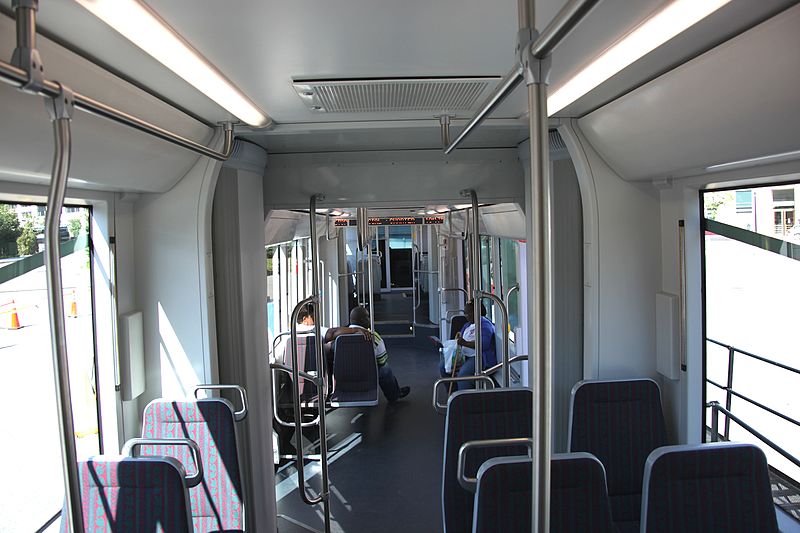
Interior of a DC streetcar constructed
in 2008, still unused.
The District Department of Transportation (DDOT) is also finalizing plans to complete the H Street/Benning Road line of the long-anticipated streetcar network, expected to start revenue-service this summer. Of course, this project has been riddled with local infighting and other delays (including a lawsuit from the original Czech firm constructing the streetcars, which have sat rusting in a railyard in NE forst several years), and so a 2013 opening may be more a matter of cosmic luck than deliberate planning.

Saturday, April 21, 2012

Eastern Market Vendor Apps, or "Make Dat Money"


Eastern Market is accepting applications from farmers for its new open-air farmers’ market that will be held on Tuesdays from 3pm – 7pm. The deadline for submitting applications is set for May 1. For those of you who have mentioned wanting to expand your hobbies into an actual small business here in DC (or know people who are thinking about it), this could be a decent opportunity. It sounds like the list is growing, but now overcrowded yet since it's a new market schedule.

Here's the application. The fee is only $35 for the Tuesday evening market, but the deadline is coming up soon. More info below, or see the full notice here.

We are thrilled to expand the outdoor market’s operations to Tuesday afternoon and look forward to reviewing applications from local farmers and vendors,” said Brian Hanlon, Acting Director of the Department of General Services, the District agency that manages the market. “As a Capitol Hill resident, Eastern Market holds a special place in my heart and I am looking forward to enjoying fresh, local groceries from a new farmers’ market at one of my favorite historic establishments in the District.”
Eastern Market management is currently accepting new farmers for the weekday market only. Farmers must be third-party certified and be a regionally-based grower or farmer. The application can be found at www.easternmarket-dc.org. Successful applicants will be expected to sell every Tuesday under the outdoor farmers’ line shed beginning in June of this year.
You can also visit the home page of our website, www.easternmarket-dc.org, to download.  Applications need to be postmarked by May 1, 2012. A non-refundable application fee applies to each application.

Friday, April 20, 2012

Street Closure Permits, or "More Block Parties!"

The District isn't a city for block parties. Public streets are rarely closed for community events focused around food, drink, fun or local music. And when they are, it's most commonly for large annual events like the Beer Festival, Saint Patrick's Day or enormous foodie fests that are more like two day concerts with big-name headliners - quite a bit of fun, but not really a "community" event. At first I thought the remarkable absence of festivities was perhaps just my own biased perception, having come out of cities like San Francisco and San Jose where neighborhood parties are almost common phenomena by comparison. But DC has no lack of micro-community organizations, sometimes encompassing no more than three or four streets.

Neighborhood parties are a great way to get to know the people living around you, and the benefits of resulting social capital in areas of social stability, poverty alleviation, human security and disaster resiliency are pretty well documented at this point. But it turns out that getting a permit for a block party in Washington is at the "stupid difficult" level.

Tuesday, April 10, 2012

New concepts designs for the Mall, or "@__@"


The Trust for the National Mall released on Tuesday concept drawings of a dozen finalists in a competition to redesign the National Mall in Washington, DC.

Since last September, architects and designers have been competing for the chance to make over areas near the Capitol, Washington Monument and Constitution Gardens, which was once imagined as a pastoral park near the Lincoln Memorial. Each of the areas under consideration were selected in order to enhance their utility as public spaces, and refurbish features that have decayed over years of use. Each of the designs would bring major changes, adding amenities including food options and restrooms.

While the proposals have been largely welcomed in feedback in social media, there have also been voices of concern that the new designs might undermine the district's historical features. But to be fair, the current theater is pretty lame compared to most of the new concepts. I mean, the new one would come with fireworks and thousands of engaged audience members > >
Some renovation would probably be good for the District's less than premium public spaces.


Check out the rest of the ideas at the Trust for the National Mall's REACT webpage.


Wednesday, June 1, 2011

Realignment and the Corrections Crisis, or "9 Fellows Walk Into a Bar..." (Pt.5)

I visited Sacramento four months ago with my fellowship cohort to meet with policy wonks, and to ask some uncomfortable questions about the state of the State. A $26B budget deficit, gridlocked politicians, a frumpy economy, a mess of jurisdictional mishaps and dozens of uncoordinated populist initiatives that don't look so hot the next morning had (and still have) all conspired to ruin everything.  Wild rumors had been flying about in San Francisco that the state was considering a wide-reaching reorientation of public services, and that local governments would expectedly "get the shaft" in these changes. That turned out to be true.

It was hailed as the great "Realignment" and in this shifting of authorities, monies and services, prison reform (kinda) made it onto the list. And rightly, considering that California has one of the largest prison populations out of any state in the Union, and that the Union has the highest per capita incarceration rate in the ENTIRE WORLD. That mean's we're the best!

My group has started working with the County Sheriff's office on a project to evaluate the levels of recidivism in San Francisco, the effectiveness of corrections programming and alternative sanctions, and CCSF's ability to adapt some of those services to a new population. It could not be timelier. The US Supreme Court last month upheld an injunction against California's Department of Corrections and Rehabilitation for civil rights violations like inadequate medical care and services, and violence, due to overcrowding (see Brown v. Plata). The number of prisoners incarcerated in California since the 1970s has increased sevenfold, and the system is now over 175% of its official inmate capacity with 143,000 prisoners (down from 173,000 in 2006). This was identified as a significant cause of the rights violations, and so the State was ordered to either (a) increase capacity and services or - since California’s annual budget is still short by several billion dollars - (b) to release or redistribute approximately 33,000 prisoners.

The ruling itself was no surprise. The case was pending for several years, and it was really a matter of time before the High Court followed up in the case - it was just a bit earlier than anyone thought. Unfortunately this means San Francisco and hundreds of other municipalities across California will be absorbing some of the State prisoners into their jails and local corrections programs. The official objective is to move low-level offenders closer to their communities, as this has shown to encourage rehabilitation and stabilization - but it's also about money and a federal injunction.


This is a new demographic for county sheriffs - more serious crimes, different affiliations, somewhat more radical behaviors, and parolees. Counties are generally ill-equipped to manage these offenders, but we have to learn. The City's expecting at least 700-800 new state prisoners next year. It's hard to know a definite number, though; the state doesn't share all inmate records that signify who's eligible for the transfer.

As a state, we need to ask some important questions, foremost of which is how our already enormous corrections system has swelled to nearly twice its official capacity. Is it the judges, or lawyers, or the police? Whoever it is, they're clearly crazy. Unfortunately the problem isn't that simple. There does not seem to be any single mechanism to blame or switch to flip that would resolve this crisis - and with costs skyrocketing, a structural state deficit, abuses gaining public attention, report after report indicating that the prison systems are often overtly and procedurally racist, and with a new court injunction, it really is a crisis for the state. 

But if I were to dismiss nuance and point to something as a fundamental structural flaw, I would start with California's infamous Three Strikes Law.

Wednesday, May 4, 2011

So....who gets the money?


I wrote an entry this past March reflecting the political controversy around redevelopment agencies in California. Governor Brown still argues that the State ought to dissolve the agencies to reclaim short-term costs to Sacramento's tax revenue, but others argue that redevelopment agencies foster long term growth and profits in areas that would otherwise not develop in the normal market.

There are examples of abuse and success for either side of the argument to hold up to the spotlight, but the San Francisco Redevelopment Agency is noted as one of the most successful cases in the program. The agency has integrated into the City's administrative framework since its incorporation in 1948 by taking on responsibilities in financing, planning and coordination in a variety of City projects, and even asserted its management capacity in increasingly complex initiatives. The SFRA now holds jurisdiction (often shared) over more than 10% of the territory of San Francisco. Active project areas include:
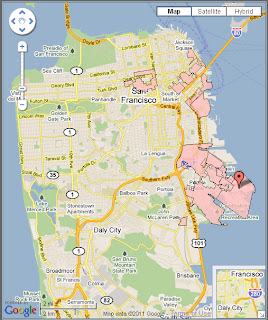
» Yerba Buena Center
» Hunters Point Shipyard
» Rincon Point/South Beach
» Bayview Hunters Point
» Bayview Industrial Triangle
» South of Market
» Mission Bay North & South
» Transbay
» Vistacion Valley


» *Treasure Island redevelopment is no longer part of SFRA, and is instead managed by the quasi-independent Treasure Island Development Authority (TIDA)


The Agency is an entity legally separate from CCSF, but it only performs certain functions authorized by the City and County of San Francisco and in areas designated as Redevelopment Zones by the Board of Supervisors.

With the threat of dissolution looming awkwardly in the air over every redevelopment conversation in San Francisco, CCSF is left with the uncomfortable task of figuring what to do with the billions of dollars in projects, contracts and funds - and 10% of San Francisco - that will have to be handed to someone else to manage. Realistically, the RA projects already underway will likely continue without intervention or suspension, but the real problem is the coming disruption to administrative services and the juggle of authority that always gets more complicated than it needs to in SF. Now, there is also a whole bunch of money, land and social justice conflict involved to upset even the most idealistic department.

Friday, April 22, 2011

The Bay could have looked like this...

In the 1960s, before the creation of BART or modern strategic transportation plans, the prospects for San Francisco looked very different than what we see today.

My fellow Fellow Eliot Chang recently forwarded me an image from his office that immediately grabbed my interest. He is part of San Francisco's Department of Public Works (DPW), and he uncovered a treasure trove of alternative proposals for bridges, tunnels, freeways and subways that were ultimately abandoned to the City's archives, but not before their designs and specs were completed. See if you can imagine them now.

Here are some of my favorites.

Alternative bridges and tunnels for trans-bay travel, circa 1967.